Hazmat placard requirements: the 454 kg rule, who supplies them, driver vs shipper
Hazmat placard requirements explained: when the 454 kg (1,001 lb) aggregate rule triggers, who is responsible for supplying placards, and the line between driver and shipper duties.
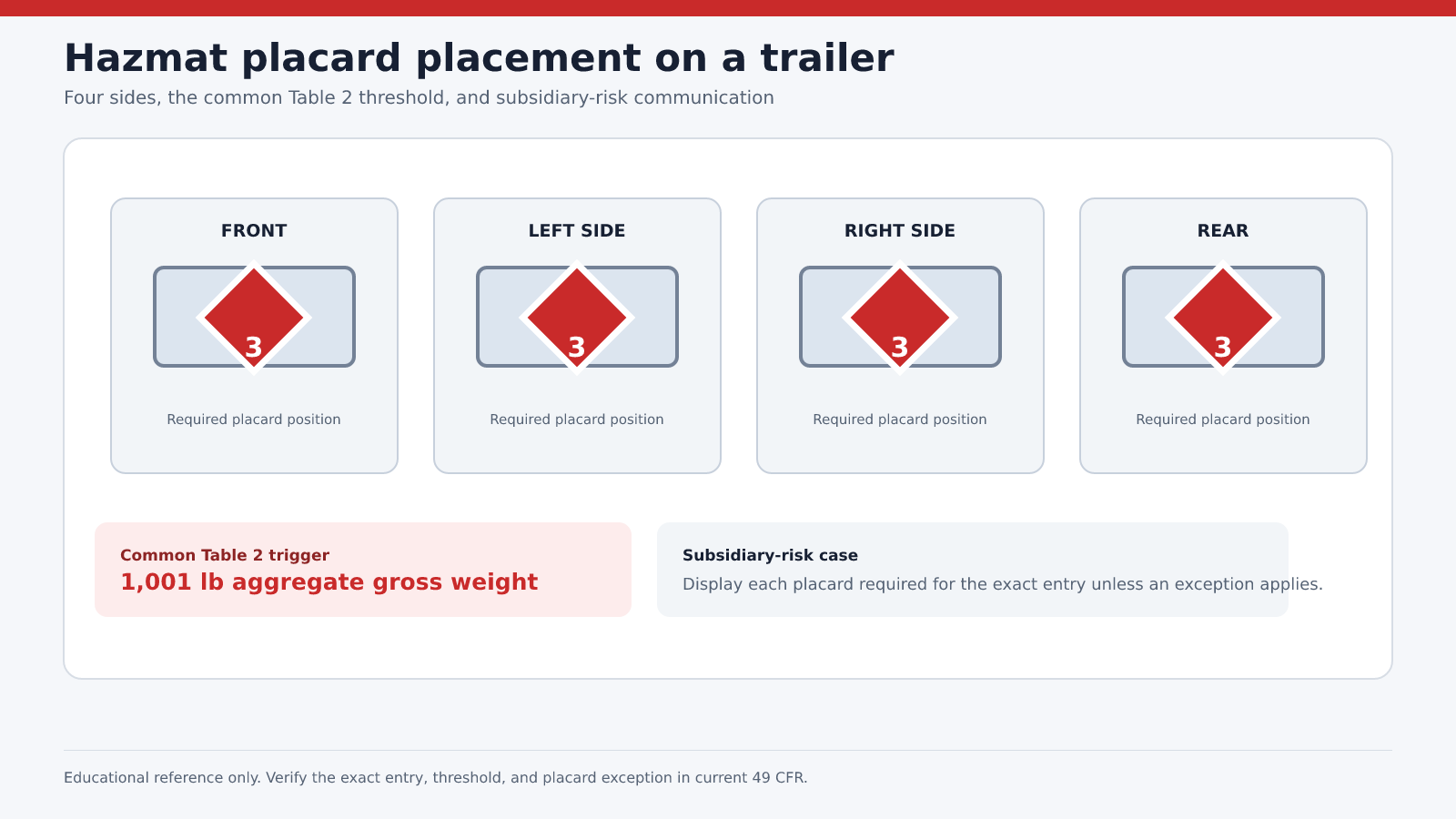
Hazmat Placards: Visibility and Responsibility
Placards communicate the primary hazard of a load to emergency responders. Getting them wrong leads to immediate fines and delayed shipments. The rules revolve around quantity, hazard type, and clear divisions of responsibility between shipper and carrier.
The 454 kg (1,001 lb) Aggregate Rule
For most common hazardous materials classified as Table 2 materials — such as Class 3 flammable liquids or Class 8 corrosives — placarding is required when the aggregate gross weight of all hazardous materials in that category on the transport vehicle reaches or exceeds 454 kg (1,001 lbs).
- Less than 1,001 lbs? No placard required for Table 2 materials.
- Exactly 1,001 lbs or more? Placards are mandatory and must be applied before the vehicle moves.
- Mixed loads: Each hazard class is calculated separately. A trailer with 600 lbs of Class 3 and 600 lbs of Class 8 does not require placards for either class individually — but a trailer with 1,200 lbs of Class 3 requires a Class 3 placard.
Table 1: Placard at Any Quantity
Certain materials are so hazardous that placarding is required at any quantity, regardless of weight. These are listed in 49 CFR 172.504 Table 1 and include:
- Division 1.1, 1.2, 1.3 Explosives
- Division 2.3 Poison Gas (including any Poison Inhalation Hazard material in any quantity)
- Division 4.3 Dangerous When Wet
- Division 5.2 Organic Peroxide (Type B, liquid or solid, temperature-controlled)
- Division 6.1 Poison Inhalation Hazard (PIH) — applies to materials listed with the letters "IB," "IC," "II," or "I" in the PIH column of the HMT
- Class 7 Radioactive (Yellow III label)
If you ship 1 lb of a Table 1 material, the truck must be placarded before it departs.
Who Supplies the Placards?
49 CFR 172.506 draws a clear line of responsibility:
- The Shipper must provide the correct placards for the motor carrier prior to or at the same time the material is loaded. The shipper is responsible for supplying the correct number, type, and class of placards.
- The Carrier must affix the placards to the vehicle and ensure they remain visible and legible throughout transit. The carrier is also responsible for maintaining placard condition — a faded, torn, or obscured placard during a roadside inspection is the carrier's violation.
Size, Placement, and Visibility Requirements
- Dimensions: A standard placard is a diamond shape measuring 273 mm (10.8 inches) on each side, with a 12.5 mm (0.5 inch) inner border.
- Placement: Must be displayed on all four sides of the transport vehicle — front, rear, and both sides. For tank cars, they go on each side and both ends.
- Clearance: Must be at least 76 mm (3 inches) away from any other markings, lettering, or advertising on the vehicle.
- Visibility: Must be clearly visible from the direction it faces, from a distance of 30 meters (approximately 100 feet). No obstructions — tarps, ladders, or equipment — may cover them.
- Color and legibility: The placard must not be washed out, faded below regulatory color thresholds, or otherwise illegible.
Driver Pre-Trip and In-Transit Duties
Drivers are responsible for verifying placards during the pre-trip inspection — before departure. Specific checks include:
- Verifying the placard type matches the shipping paper's hazard class
- Confirming placards are securely attached on all four sides
- Checking for physical damage or dirt that could reduce legibility
Drivers must also re-verify placard condition after any transfer of cargo, and before entering jurisdictions with specific hazmat routing restrictions (tunnels, bridges, urban corridors).
Prohibited Placard Violations
A placard may not display any information other than required content. Adding marketing text, a company logo, or extraneous symbols on a hazmat placard is a federal violation. Orange panels used in European ADR transport (which display the UN number and Kemler code) are not the same as DOT placards and are not DOT-compliant.
This guide is for educational purposes only. Always verify requirements against 49 CFR and consult your designated hazmat counsel before shipping.
Ready to ship?
Post a hazmat load and get matched with endorsed carriers in under 2 minutes.