Hazmat segregation table: what can't ride together
The hazmat segregation table decoded: which incompatible classes cannot ride together, how to read 49 CFR 177.848, and load-planning rules that prevent costly rejections.
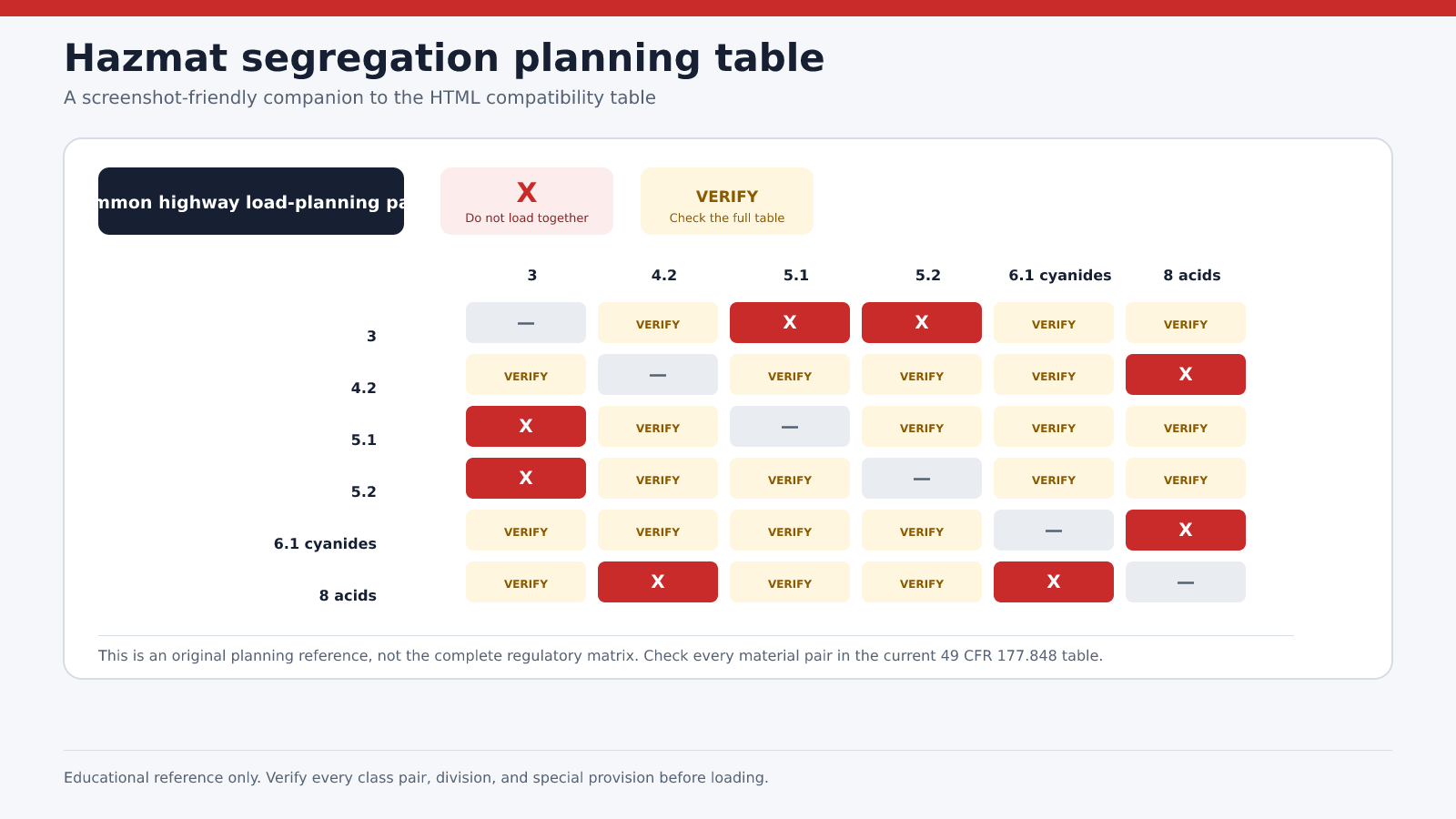
Hazmat Segregation in Load Planning
Hazardous materials cannot be loaded into a trailer randomly. Certain chemical families react catastrophically if their packagings fail and the materials mix. The DOT mandates strict segregation rules under 49 CFR 177.848 for highway transport and 49 CFR 174.81 for rail.
The Segregation Table: Reading It Correctly
The segregation table in 49 CFR 177.848 uses a matrix format where hazard classes and divisions are listed on both axes. Each cell contains one of the following codes:
| Code | Meaning |
|---|---|
| (blank) | No restriction. Materials can be co-loaded without separation. |
| X | These materials may not be loaded, transported, or stored together on the same vehicle under any circumstances. |
| O | These materials may not be loaded together unless they are separated so they cannot commingle in the event of a leak. |
| A | Applies specifically to Division 1.1 or 1.2 explosives. |
High-Priority "X" Conflicts (Do Not Load Together)
These combinations are prohibited regardless of quantity, packaging integrity, or customer preference:
Class 3 (Flammable Liquids) + Class 5.1 (Oxidizers) or 5.2 (Organic Peroxides): Mixing fuel with a concentrated oxygen source creates an extreme fire and explosion risk. This is the most common segregation error in chemical distribution. A trailer carrying solvent-based adhesives (Class 3, PG II) and calcium hypochlorite pool shock (Class 5.1) is a moving bomb.
Class 8 (Acids) + Class 6.1, Group (Cyanides): A strong acid mixed with a cyanide salt generates hydrogen cyanide gas — immediately dangerous to life at concentrations above 50 ppm. This segregation is absolute and enforced by both DOT and OSHA in warehouses.
Class 4.2 (Spontaneously Combustible) + Class 8 (Corrosive Liquids): High risk of spontaneous ignition. Pyrophoric materials (Division 4.2) ignite on contact with moisture and can react violently with strong acids.
Class 1.1/1.2/1.3 (Explosives) + Class 3, 4, 5: Explosives may not be co-loaded with any flammable material. Period.
What "Separated" Actually Means in Practice
When the table requires an "O" (separated), the word has a specific meaning under 49 CFR 177.848(d). Acceptable separation means the materials must be loaded so that, if one package leaks, the released material cannot reach the other. In a dry van:
- Solid barrier separation: Loading hazmat at opposite ends of the trailer, with non-hazardous freight (pallets of dry goods, non-reactive materials) serving as a full-width physical barrier between them.
- What does NOT count as separation: Placing an empty wooden pallet between two drums. A cardboard baffle does not count. Air gap alone does not count.
The carrier's driver and terminal manager must understand and enforce this. If you tender a load that requires "O" separation and the carrier cannot achieve it given their existing freight on the trailer, they must decline your shipment.
Shipper Responsibilities for Segregation
The shipper is responsible for informing the carrier of any segregation requirements that apply to the freight being tendered. This is typically done via:
- Notation on the BOL: "Class 3 materials — do not co-load with oxidizers per 49 CFR 177.848"
- Verbal communication to the terminal manager before pickup
- Including the segregation requirement in the load tender for contract carriers
If you are shipping a mixed hazmat load (multiple UN numbers, multiple classes), the shipping paper must list all hazardous materials. Each pair must be checked against the segregation table. This is the shipper's job, not the carrier's.
LTL Terminal Reality
LTL carriers run highly mixed loads. When a Class 8 corrosive enters the terminal, the dock supervisor must ensure it does not get loaded onto a linehaul trailer carrying a Class 5.1 oxidizer in another customer's shipment. This is genuinely difficult at scale — which is why LTL carriers with robust hazmat programs are worth a significant premium over spot carriers with no formal segregation procedures.
This guide is for educational purposes only. Always verify requirements against 49 CFR and consult your designated hazmat counsel before shipping.
Ready to ship?
Post a hazmat load and get matched with endorsed carriers in under 2 minutes.