Limited quantity hazmat rules: meaning, exemptions & placards
What limited quantity means for hazmat shipping, which materials may qualify, LQ package marking rules, exemptions, and when placards can still apply.
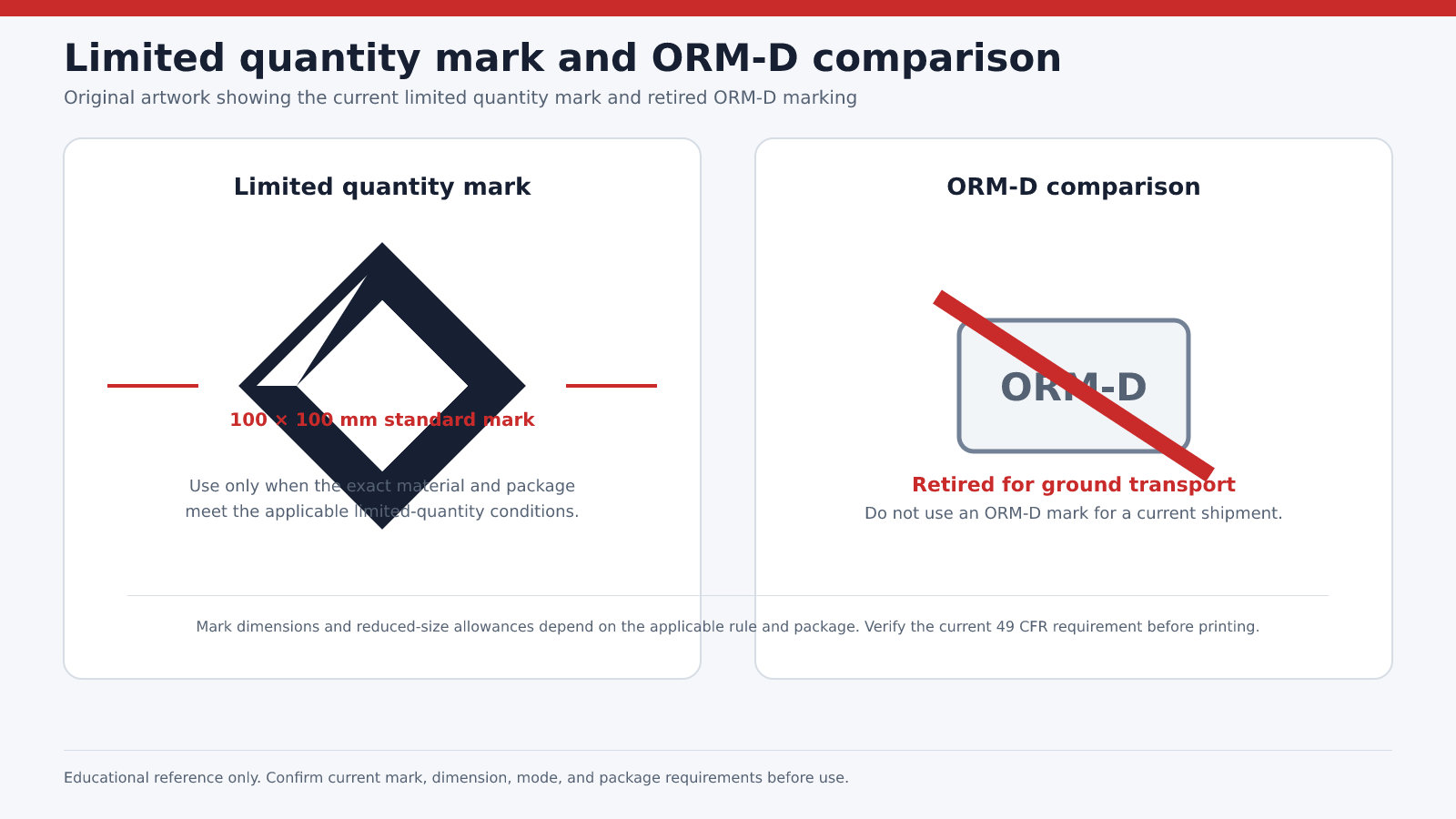
Limited Quantity (LQ) vs Fully Regulated
Limited quantity, often written as "LQ" or "Ltd Qty," is a packaging exception for some hazardous materials shipped in small inner receptacles within a strong outer package. It can change package marking and some transportation communication requirements, but it does not make a hazardous material unregulated. The specific Hazardous Materials Table entry controls whether the exception is available.
What does limited quantity mean?
A shipment may use the limited quantity exception only when the named material, packing group, inner packaging capacity, outer package, and transport mode meet the applicable rule. The exact limits are material-specific. Check the HMT's quantity columns and the applicable section in 49 CFR Part 173; do not assume that every Class 3, Class 8, or retail-size product qualifies.
Packaging and marking requirements
For a combination package using the exception, the inner receptacles must be protected by a strong outer package. The outer package must meet the applicable mass and construction limits. Ground LQ packages are generally marked with the black-and-white square-on-point limited quantity mark; air shipments use the air-transport variation when required. The correct mark, orientation arrows where applicable, and any additional marks must match the exact shipment.
What LQ can exempt
For eligible domestic ground shipments, the limited quantity exception can change certain package, label, and shipping paper requirements. It may also affect vehicle placarding requirements. The available relief is not identical for every material or mode, so use the material's specific regulatory entry rather than a general LQ checklist.
What LQ does not exempt
LQ does not remove the shipper's responsibility to correctly classify, package, mark, and offer the material. It does not override carrier acceptance rules, state requirements, or site-specific receiving requirements. Some materials, packages, and conditions are excluded from the exception entirely.
Are placards required for limited quantity?
Placard requirements depend on the material, shipment configuration, and applicable exception. An LQ mark on a package is not the same thing as a vehicle placard. Before dispatch, verify the shipment against 49 CFR §172.504 and the specific limited quantity provision, especially if the load also contains fully regulated hazardous materials.
Limited quantity vs fully regulated
A fully regulated shipment follows the complete set of requirements that apply to its entry, including the required packaging, markings, labels, shipping description, and vehicle placarding threshold. An LQ shipment uses a narrow exception. If any package exceeds its limit, is packed incorrectly, or falls outside the material-specific exception, it must be offered under the full requirements.
Limited quantity checklist
- Confirm the proper shipping name, UN/NA number, hazard class, and packing group.
- Verify that the material's HMT entry allows the exception.
- Check each inner receptacle and outer package against the applicable limit.
- Apply the correct LQ mark and any required additional marks or labels.
- Confirm the mode and carrier will accept the shipment under the exception.
- Keep current classification and packaging documentation available for review.
For paint and packaged lubricants, see the shipping paint and lubricants guide. For the vehicle-side threshold question, use the placard checker as an educational starting point and verify the applicable rule.
This guide is for educational purposes only. Always verify requirements against 49 CFR and consult your designated hazmat counsel before shipping.
Ready to ship?
Post a hazmat load and get matched with endorsed carriers in under 2 minutes.